


Ask ten cultivators why a room underperformed and most will point at the nutrients. In our experience across commercial facilities, that’s almost never where the problem starts — and it’s exactly why commercial cannabis fertigation has become the backbone of consistent grows. The recipe is usually fine. What breaks down is everything that delivers it — water quality, pressure, piping, and how consistently that solution reaches the root zone. That’s the job of fertigation, and getting it right is the difference between a room that drifts and a room that performs the same way every cycle.
This guide covers what commercial cannabis fertigation actually is, when it’s worth automating, the components that make or break a system, and the mistakes we see most often. If you want the complete playbook, our free 14-chapter field guide goes deeper on every section below.
What is commercial cannabis fertigation?
Fertigation is exactly what the name implies — fertilizer plus irrigation. Instead of hand-mixing nutrients and watering by hand, a fertigation system injects a precise nutrient solution into irrigation water and delivers it straight to the root zone, usually through drip emitters. Done well, every plant in a zone receives the same volume, the same EC, and the same pH, on the same schedule.
That consistency is the entire point. Cannabis is a high-value crop that rewards precision, and small inconsistencies in feed — a little more here, a little less there — compound across thousands of plants into uneven canopies, uneven harvests, and yield you can’t predict.
When does fertigation make sense?
You’ll hear a common rule of thumb: once your canopy passes about 10,000 square feet, hand-watering stops being practical. That part is true — at that size, watering by hand is slow, inconsistent, and ties up skilled labor on a task that doesn’t need it. But it’s the wrong place to draw the line, even if the wider industry (Cannabis Business Times included) often frames it that way.
The benefits that actually make fertigation worth it — identical feed to every plant, precise dosing, the ability to crop steer, and the labor you get back — show up long before 10,000 square feet. We run the Paragon on much smaller grows, and those cultivators see the same consistency and control as the big rooms.
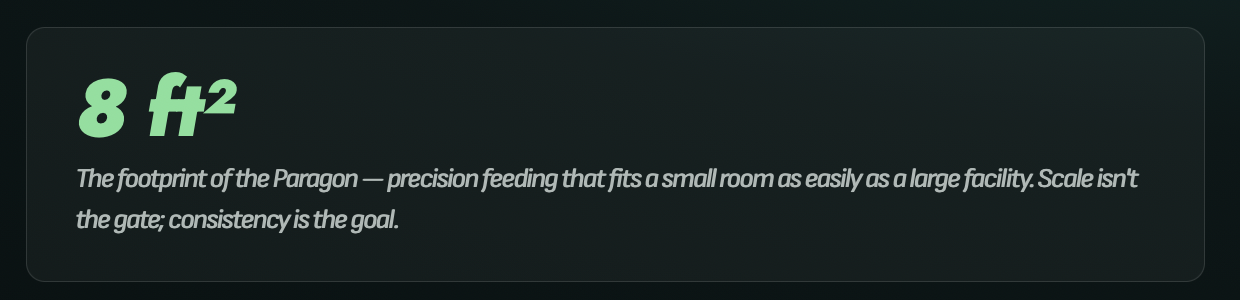
So the real question isn’t square footage. It’s whether you want every plant fed the same way, every cycle. If you do, fertigation earns its place at almost any scale — automation just frees you from the hose to focus on the decisions that move yield.

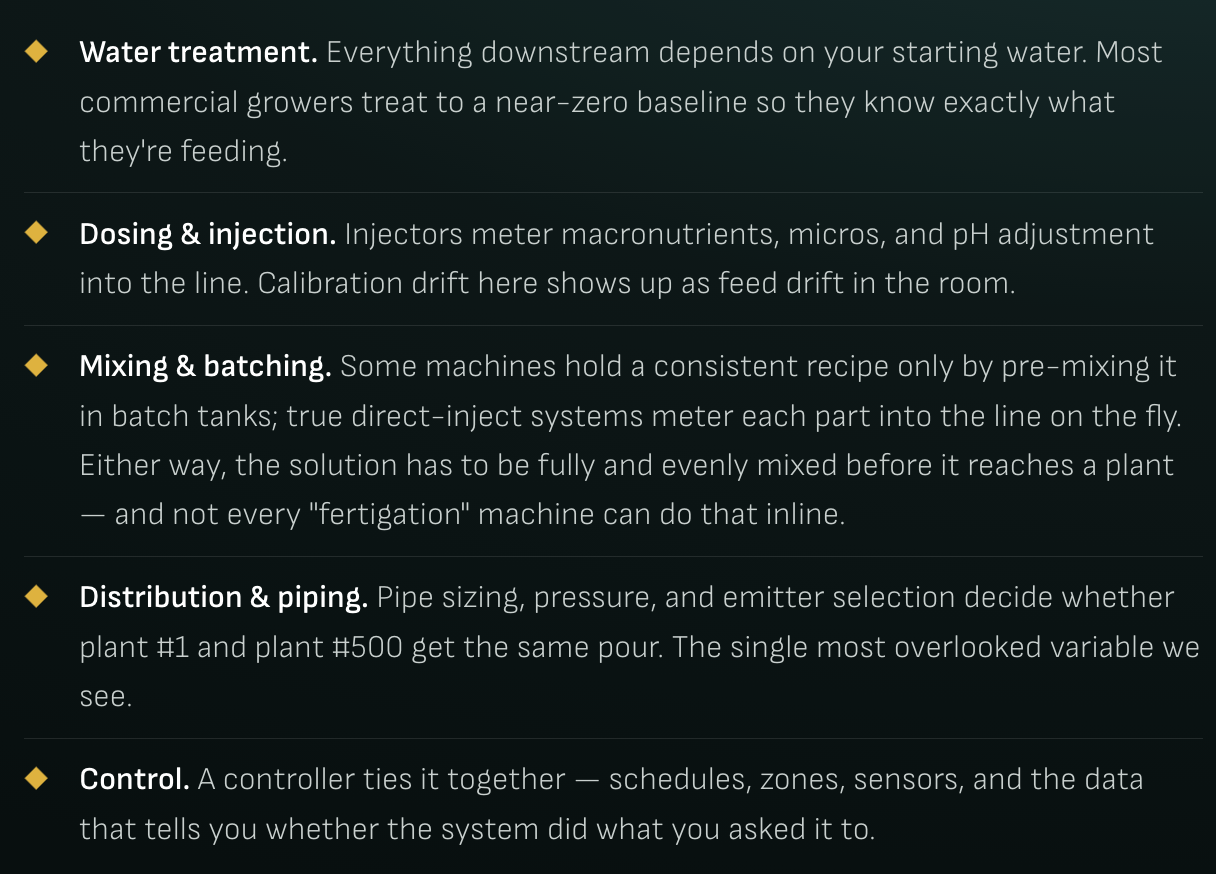
The five components — and where they fail at the seams
Most fertigation systems share the same building blocks. Failures rarely happen inside a component; they happen at the seams between them.
Water Comes First
If we could get every grower to fix one thing before touching their nutrient line, it would be water. pH and EC get all the attention, but they’re downstream symptoms. Source-water chemistry, line pressure, and flow across the system are what quietly throw a feed off. Treat and stabilize your water, size your piping for even pressure, and a surprising number of “nutrient problems” disappear on their own. We go deep on this in our guide to water quality for cannabis fertigation.
8 fertigation mistakes that quietly cost yield
Across the facilities we’ve worked in, the same issues show up again and again: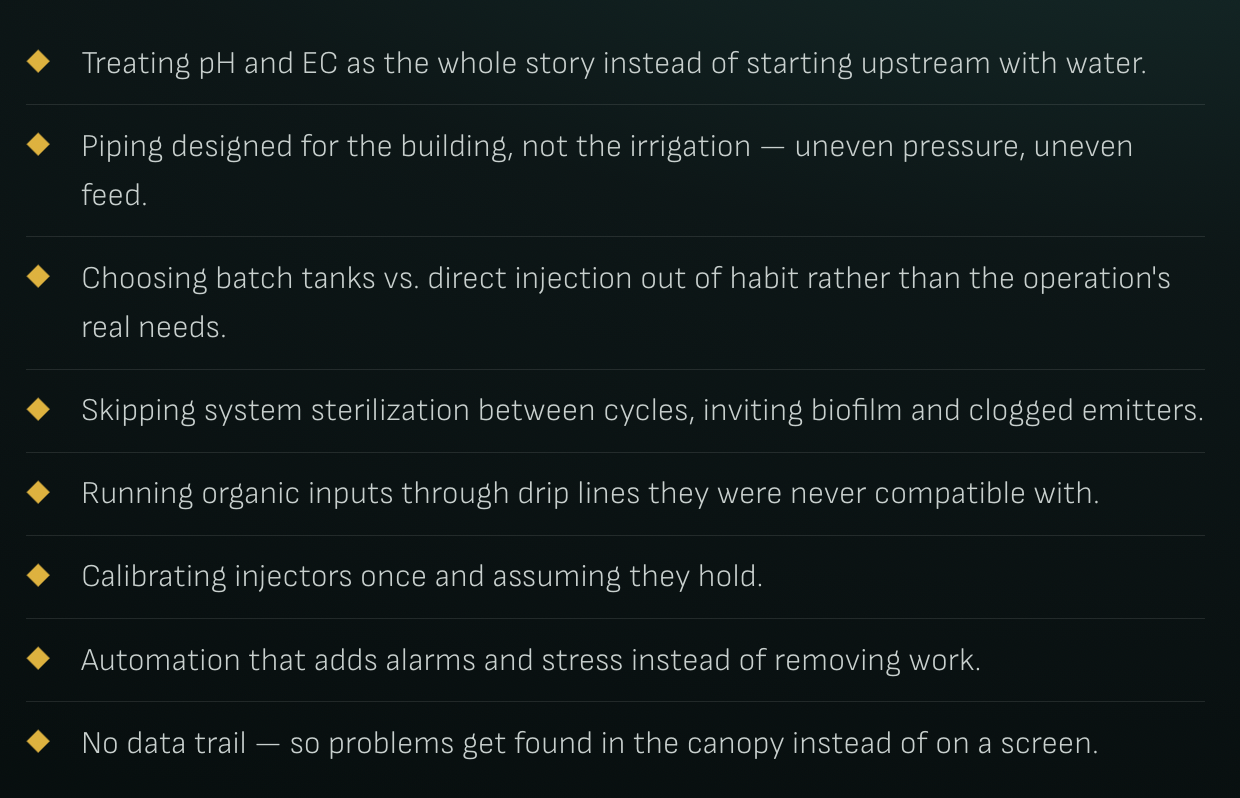
We break down all eight, and how to fix each, in Chapter 9 of the free guide. It’s the chapter growers tend to screenshot.
Crop steering: turning consistency into control
Once your feed is consistent, fertigation becomes a lever, not just a chore. By adjusting irrigation frequency, shot size, and recipe by growth stage, you can steer plants toward vegetative or generative responses on purpose — the practice known as cannabis crop steering. But you can’t steer a system that isn’t consistent in the first place — which is exactly why the unglamorous fundamentals (water, pressure, piping, calibration) matter so much.
The ROI of getting it right
A fertigation system is an investment — depending on scale and sophistication, anywhere from a few thousand dollars to the high tens of thousands. (We break the numbers down in what a cannabis fertigation system costs.) But the return isn’t only labor savings. It’s predictable harvests, tighter water and nutrient use, fewer crop losses, and the recordkeeping that keeps you compliant. The most expensive fertigation system is the one that’s dialed in wrong.

What is fertigation in cannabis cultivation?
Fertigation combines fertilization and irrigation: a system injects a precise nutrient solution into irrigation water and delivers it to the root zone, usually through drip emitters, so every plant gets the same volume, EC and pH on the same schedule.
At what size should I automate fertigation?
There’s no hard cutoff. Hand-watering clearly breaks down around 10,000 sq ft of canopy, but the consistency, precision and labor savings that make fertigation worthwhile show up at much smaller scales too — plenty of smaller grows run automated fertigation and see the same gains.
Is fertigation the same as hydroponics?
No. Both deliver nutrients through water, but hydroponics uses inert media while fertigation typically feeds plants in substrates like coco coir, which buffer nutrients and make conditions easier to maintain.
What’s the most common fertigation mistake?
Treating pH and EC as the whole story. Most feed problems start upstream with water quality, line pressure and piping design — fix those first and many nutrient issues disappear.

Beyond Cannabis
While this guide focuses on cannabis, commercial fertigation isn’t cannabis-specific. Greenhouse vegetable growers, hydroponic and vertical farms, nurseries, and specialty-crop producers rely on the same precision dosing and automation to control quality and cut waste at scale. If you grow anything with irrigation, the principles here apply.

Pre-Harvest Flush: How (and Whether) to Flush Your Crop
The pre-harvest flush is the final step of the grow — the stretch where you stop feeding and water with plain, clean water to clear

Biofilm & Clogged Emitters: Keep Your Drip Lines Clean
A clogged emitter is a plant that isn’t getting fed. It happens quietly — one dripper slows, then a few, and suddenly you’ve got dry

Hard Water & Alkalinity: What Growers Need to Know
Hard water and alkalinity are two of the most misunderstood — and most damaging — problems in a grower’s source water. They quietly push your

Root Rot & Pythium: How to Prevent and Treat It
Root rot is the silent killer of the grow room. By the time you see it up top — wilting, yellowing, stunting — the damage
Pre-Harvest Flush: How (and Whether) to Flush Your Crop
The pre-harvest flush is the final step of the grow — the stretch where you stop feeding and water with plain, clean water to clear
Biofilm & Clogged Emitters: Keep Your Drip Lines Clean
A clogged emitter is a plant that isn’t getting fed. It happens quietly — one dripper slows, then a few, and suddenly you’ve got dry
Hard Water & Alkalinity: What Growers Need to Know
Hard water and alkalinity are two of the most misunderstood — and most damaging — problems in a grower’s source water. They quietly push your
Root Rot & Pythium: How to Prevent and Treat It
Root rot is the silent killer of the grow room. By the time you see it up top — wilting, yellowing, stunting — the damage