

TINY BUBBLES WITH A HUGE IMPACT
Nanobubbles are 2500x smaller than a grain of salt. They improve water quality, enhance water treatment processes, and improve productivity in agricultural applications. Tiny bubbles, outsized results.
- Increased Oxygen in Root Zone
- Enhanced Nutrient Uptake
- Eliminate Biofilm
- Pathogen Protection
- Boosted Production
- Reduced Build-up
- Better Root Development
- Sustainable and Efficient

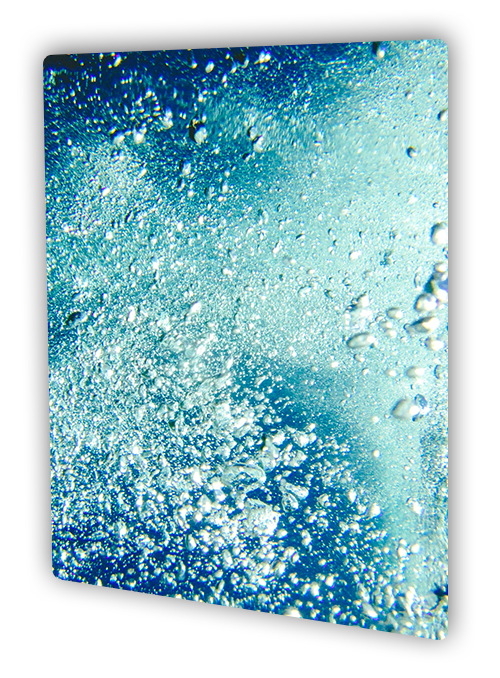
What a nanobubble actually is
A nanobubble is a gas bubble under roughly 200 nanometres across — small enough that about 2,500 of them would span a single grain of table salt. At that scale, bubbles stop behaving like bubbles.
An ordinary aeration bubble rises, reaches the surface and pops, which is why conventional aeration has to run constantly just to hold a dissolved oxygen reading. A nanobubble is small enough that buoyancy barely acts on it, and it carries a slight negative surface charge that stops it merging with its neighbors. So instead of surfacing in seconds, nanobubbles stay suspended in the water column — and they travel wherever the water travels. Down the mainline, through the emitters, into the root zone.
That persistence is the entire point. You are not aerating a tank. You are putting oxygen into the water itself and delivering it to the roots.
What that does in a grow
Oxygen where the roots are
Roots respire, and so do the aerobic microbes you want around them. Waterlogged, oxygen-poor media favors the opposite crowd — the anaerobic organisms behind root rot and Pythium. Raising dissolved oxygen at the point of delivery shifts that balance in your favor.
Nutrient uptake
Root respiration is what powers active nutrient transport. Better-oxygenated roots are simply better at taking up what you are already feeding them, which is why growers often see the same recipe perform better without touching the recipe.
Biofilm and build-up
This is the effect our customers notice first, because it is visible. Nanobubbles disrupt the anaerobic conditions biofilm depends on inside pipes and drippers.
Water temperature matters less
Cold water holds more dissolved oxygen than warm water. That is a large part of why growers buy chillers — not because roots want cold, but because cold water carries oxygen. Nanobubbles put oxygen into the water directly, so dissolved oxygen stops being purely a function of temperature and you can hold a high reading at warmer water temps. Worth being clear about the limit: if you are chilling to control root-zone temperature or to suppress pathogens, that reason does not disappear. But if you were chilling mainly to hold DO, this changes the maths.
It reaches the last plant
Aerating a reservoir raises oxygen in the reservoir. Ordinary bubbles rise and burst, so much of it is gone before the water leaves the tank, and the far end of a long run gets whatever survived the trip. Nanobubbles stay suspended and travel with the water, so the plant at the end of the line gets treated water too — the same argument as pressure-compensating emitters, applied to oxygen.
Fewer chemical interventions
Cleaner lines and better-oxygenated water usually mean leaning less on sanitizers and line-cleaning chemistry — one less thing perturbing the EC and pH you worked to dial in.
WORKING WITH THE BEST
PROFESSIONAL PEACE OF MIND


Nik Knowledge Drop
NANOBUBBLE TIP
“We’ve seen biofilm immediately leave pipes after installing a nanobubble system. Algae on tanks and trays is gone. The plants truly thrive with the extra oxygen.”
— NIK MCCALLIGAN, OWNER & PRESIDENT
Where nanobubbles earn their keep, and where they do not
They pay back fastest in recirculating systems, in any grow fighting biofilm or clogging emitters, in warm rooms where water simply holds less oxygen, and in operations already running tight feed schedules where root health has become the limiting factor.
They matter less if your water is already cold, well-oxygenated and moving quickly — or if your real constraint is somewhere else entirely. Undersized piping, an unbalanced drip layout, or source water you have not treated yet will all cost you more than low dissolved oxygen does. We would rather point you at the actual bottleneck than sell you a generator you do not need.
Fitting it to a system you already run
A nanobubble generator is an inline addition, not a rebuild. It sits on your existing water loop and works alongside RO, filtration and UV rather than replacing any of them, and most installs go in without touching the irrigation design.
We work with Moleaer and with other nanobubble platforms, and we will spec whichever one suits your water and your loop rather than defaulting to a single brand.
If water treatment work is already on your list, doing both at once costs less than doing them separately — and it means one team sizing both against the same numbers.
From the Field Guide
HOW DO I START?
Talk to an Eden rep about whether nanobubbles make sense for your facility. In most cases, they do.